

Gooseneck vs. Bumper Pull Trailer: Which Should I Buy?
Whether you are buying a dump trailer for construction work, a flatbed for hauling farm equipment, or a utility trailer for your business, you have to make a fundamental design choice right out of the gate: Gooseneck or Bumper Pull?
The hitch style you choose doesn’t just dictate how the trailer connects to your tow vehicle—it completely changes how your truck handles, how much weight you can carry, and how easy the trailer is to maneuver.
Let’s break down the core differences so you can buy the configuration that fits your workflow.
What is a Bumper Pull Trailer?
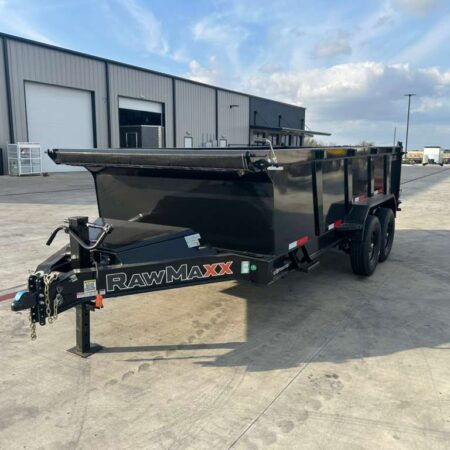
Despite the name, modern “bumper pull” trailers don’t actually hook up to your bumper. Instead, they connect to a frame-mounted receiver hitch below your truck’s tailgate using a standard ball and coupler.
The Pros:
- Universal Compatibility: Anyone with a standard SUV or truck can hook up to a bumper pull trailer. You don’t need an open truck bed or specialized hardware installed inside the cab.
- Lower Initial Cost: Bumper pull models are generally less expensive to manufacture than goosenecks, saving you money upfront.
- Full Bed Availability: Because the hitch sits behind your truck, your entire truck bed remains wide open for tools, fuel tanks, or cargo.
The Cons:
- Sway Potential: Because the pivot point sits behind the rear axle, bumper pull trailers are more susceptible to trailer sway from high winds or passing semi-trucks.
- Weight Restrictions: They generally top out at lower weight ratings compared to goosenecks due to leverage limits on the rear hitch.
What is a Gooseneck Trailer?
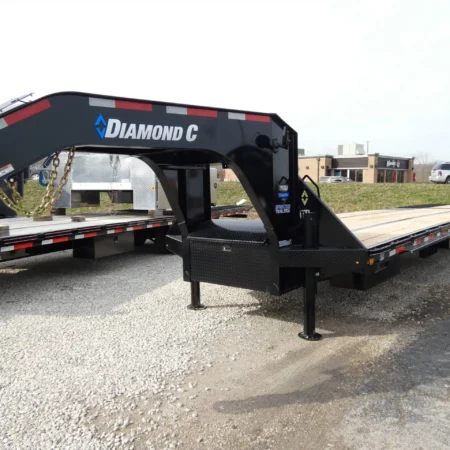
A gooseneck trailer features a long, arched neck that reaches over your truck’s tailgate and connects to a hitch ball installed directly into the bed of your truck, mounted over or slightly ahead of the rear axle.
The Pros:
- Unmatched Stability: By placing the trailer’s tongue weight directly over the truck’s rear axle rather than behind it, you drastically reduce trailer sway and improve overall steering control.
- Tighter Turning Radius: Goosenecks allow you to make sharper turns and jackknife the trailer at up to 90-degree angles, which is a lifesaver in tight job sites, narrow barnyards, or dead-end roads.
- Higher Weight Capacity: The truck frame can handle significantly more vertical load from a bed-mounted ball, allowing for heavier commercial payloads.
The Cons:
- Truck Restrictions: You must use a pickup truck with an open bed or flatbed equipped with a gooseneck hitch ball setup. It completely rules out using SUVs.
- Lost Bed Space: The nose of the trailer swings over your truck bed, requiring clearance and limiting what you can store back there while towing.
Gooseneck vs. Bumper Pull: Head-to-Head Comparison
| Feature | Bumper Pull | Gooseneck |
| Hitch Location | Below tailgate (frame-mounted receiver) | Inside truck bed (over rear axle) |
| Max Common GVWR | Up to 14,000 lbs (typically) | 14,000 lbs to 25,000+ lbs |
| Turning Radius | Limited (susceptible to clipping truck bumper) | Sharp (up to 90-degree maneuverability) |
| Highway Stability | Moderate (benefits from sway control hitches) | Exceptional (minimal sway or wind drift) |
| Price Point | Budget-friendly | Premium (higher manufacturing costs) |
The Verdict: Which Design Wins?
Buy a Bumper Pull if:
You need a versatile trailer that multiple drivers or different vehicles in your fleet can pull. It’s ideal for lighter loads (under 10,000 to 12,000 lbs), shorter trips, and operators who need to keep their truck beds clear for work gear.
Buy a Gooseneck if:
You are routinely hauling heavy payloads near or above 14,000 lbs, traveling long distances on the highway, or navigating tight spaces. The dramatic increase in stability, safety, and turning precision easily outweighs the extra upfront cost.
