...
Home
Shop
Wishlist0
Recently Viewed

Do I Need a CDL License for My Utility Trailer?

Do I Need a CDL License for My Utility Trailer?

There is a massive amount of misinformation floating around about whether or not you need a Commercial Driver’s License (CDL) to pull a trailer. You’ll hear some folks swear that “any trailer over 10,000 lbs requires a CDL,” while others claim “if it’s for personal use, you never need one.”

The truth is somewhere in the middle, regulated by a strict mathematical formula set by the Federal Motor Carrier Safety Administration (FMCSA).

If you are trying to stay legal while hauling tools, equipment, or dump loads, here is the exact breakdown of how weight ratings, commercial status, and state lines dictate whether you need a CDL.

The Golden Formula: Understanding GCWR

Whether or not you need a CDL isn’t determined by what your truck and trailer actually weigh on a scale today. It is entirely based on their GVWR (Gross Vehicle Weight Rating)—the maximum weight the manufacturer states the vehicle can legally carry when fully loaded.

To find out if you cross the federal CDL threshold, you must look at your GCWR (Gross Combination Weight Rating). You calculate this using a simple math problem:

$$\text{Truck GVWR} + \text{Trailer GVWR} = \text{GCWR}$$

The Federal Rule for a Class A CDL

Per federal regulations, you cross into Class A CDL territory only if both of the following conditions are met simultaneously:

  1. The combined weight rating (GCWR) of your truck and trailer is 26,001 lbs or more.
  2. The trailer’s individual GVWR is more than 10,000 lbs.

Real-World Examples: When Do You Need a CDL?

To see how this works on the job site, let’s look at how the exact same utility trailer changes requirements based on the truck pulling it.

Scenario A: The Non-CDL Setup (Under 26,001 lbs)

  • Your Truck: A standard 3/4-ton gas truck (GVWR: 10,000 lbs)
  • Your Trailer: A heavy-duty tandem-axle utility or dump trailer (GVWR: 14,000 lbs)
  • The Math: $10,000 + 14,000 = 24,000\text{ lbs}$ GCWR.
  • The Verdict: No CDL required. Even though the trailer is well over 10,000 lbs, the total combined package stays safely under the 26,001-lb limit.

Scenario B: The Class A CDL Setup (Over 26,001 lbs)

  • Your Truck: A 1-ton dually work truck (GVWR: 14,000 lbs)
  • Your Trailer: The exact same tandem-axle trailer from above (GVWR: 14,000 lbs)
  • The Math: $14,000 + 14,000 = 28,000\text{ lbs}$ GCWR.
  • The Verdict: Class A CDL REQUIRED. Because the truck is heavier, your total capacity pushes past 26,001 lbs, and because the trailer is rated over 10,000 lbs, you legally need a commercial license.

Commercial vs. Personal Use: The Big Gray Area

The “C” in CDL stands for Commercial. If you are using your truck and trailer strictly for personal use—such as moving your own furniture to a new house or hauling your personal project car—federal CDL rules generally do not apply to standard trucks.

However, DOT officers look closely at what constitutes a “business purpose.”

Warning: If you are a landscaper hauling a commercial lawnmower, a contractor carrying shingles to a job site, or a farmer transporting cattle to an auction where you will make a profit, you are operating in commerce. At that point, the weight formulas apply strictly, and you can face heavy fines if you are caught hauling without the proper license class.

How Trailer “De-Rating” Can Help You Avoid a CDL

Because the 14,000-lb trailer trailer class is so popular among contractors, many buyers run into a wall when pairing them with beefier 1-ton trucks. To solve this problem legally, many high-quality trailer manufacturers offer a service called de-rating.

If you know you will never actually carry more than 6,000 or 7,000 lbs of payload, a manufacturer can intentionally plate a 14,000-lb capable trailer with a 12,000-lb or 9,990-lb GVWR safety sticker straight from the factory.

By lowering the official paperwork rating on the VIN tag, you can safely hook the trailer up to a larger work truck without pushing your combined GCWR over the magic 26,001-lb CDL line.

Summary Checklist: Stay Safe & Legal

Before you hook up your trailer and hit the highway, double-check your driver’s side door sticker and your trailer’s VIN plate:

  • Check the truck GVWR.
  • Check the trailer GVWR.
  • Ensure the combined sum is under 26,001 lbs if you want to avoid a Class A license.
  • Always check your specific state’s DMV guidelines, as a handful of states (like California and Texas) have unique non-commercial class endorsements for exceptionally long or heavy personal rigs.

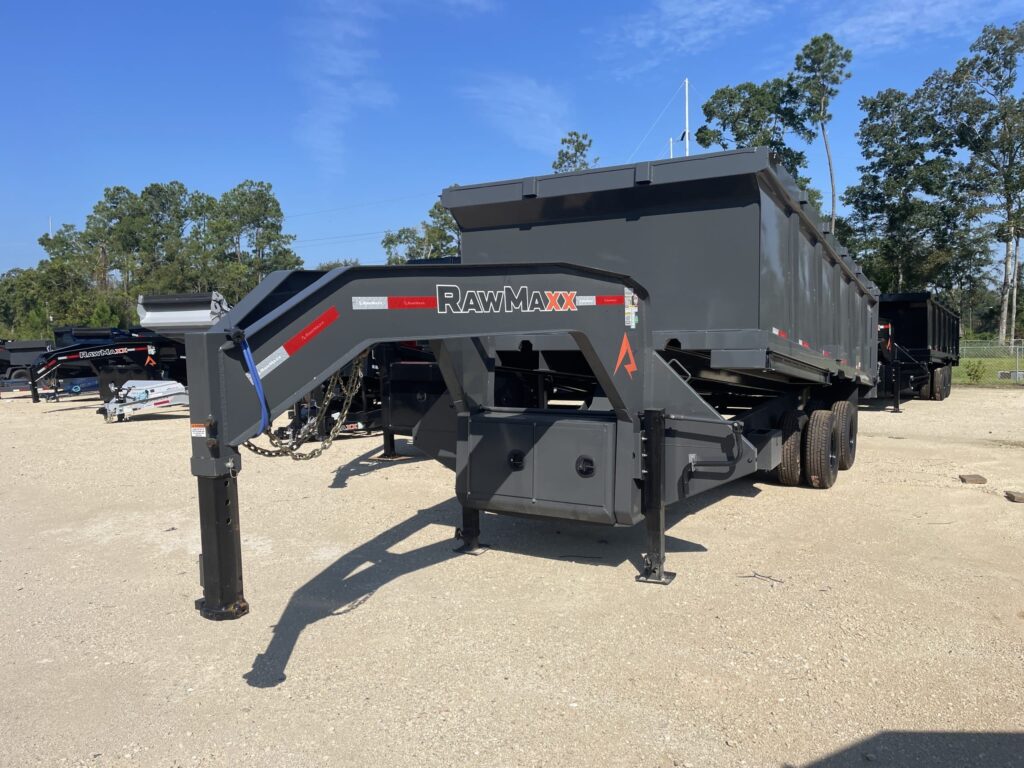
Why Are Gooseneck Trailers Easier to Back Up?

Why Are Gooseneck Trailers Easier to Back Up?

If you ask anyone who routinely hauls heavy equipment, dump loads, or livestock, they will almost always tell you the same thing: backing up a gooseneck trailer is vastly easier than backing up a conventional bumper pull.

If you’ve only ever backed up a standard utility or camper trailer, this might sound counterintuitive. Goosenecks are often much longer and heavier.

However, the secret isn’t the size of the trailer—it’s the location of the pivot point. Here is the breakdown of the physics and mechanics that make a gooseneck trailer a dream to maneuver in reverse.

1. The Pivot Point Sits Over the Axle, Not Behind It

The single biggest reason a gooseneck is easier to back up comes down to where the trailer connects to your truck.

  • Bumper Pull: Connects 3 to 4 feet behind your truck’s rear axle.
  • Gooseneck: Connects directly over (or slightly ahead of) your truck’s rear axle inside the bed.

When you turn your steering wheel to back up a bumper pull, your truck’s rear bumper swings in the opposite direction first. This creates an extreme lever effect that forces the trailer to react violently to even tiny steering inputs.

With a gooseneck, because the trailer pivots directly on top of the axle, the trailer tracks smoothly with the movement of the truck’s rear tires. There is no “bumper overhang” acting as a secondary lever, which means the trailer responds predictably and progressively.

2. Slower, More Forgiving Reaction Time

Because of that bumper overhang lever effect, bumper pull trailers are notoriously twitchy. Turn the steering wheel a fraction of an inch too far, and a bumper pull will quickly over-rotate, forcing you to pull forward and straighten out.

A gooseneck reacts much more slowly and predictably to your steering adjustments.

The Delay Benefit: This slower reaction time gives you a massive buffer. If you make a mistake or over-steer while backing into a tight barn door or job site slot, you have plenty of time to see it happening in your side mirrors and correct your path before the trailer gets away from you.

3. An Incredible 90-Degree Turning Radius

If you get a bumper pull trailer into too sharp of an angle while backing up, the tongue of the trailer will slam right into your truck’s rear bumper or corner panel. You are physically limited by how sharp you can jackknife the setup.

Because a gooseneck neck arches up and over your tailgate, there is no frame at bumper height to collide with. You can back a gooseneck up at a strict 90-degree angle to your truck without damaging either vehicle. This allows you to pivot the trailer on a dime, swinging the rear end into tight loading docks or parking stalls that a bumper pull could simply never reach.

The One Catch: It Takes More Room to Start the Turn

While goosenecks are far more predictable and offer sharper angles, they do require one minor adjustment if you’re used to a bumper pull: they take longer to start turning.

Because the pivot point is over the axle, you have to drive a bit further past your parking spot before you start cutting the wheel to initiate the back-up process. But once that turn is initiated, keeping it on a straight, controlled line is significantly less stressful.

The Bottom Line

Gooseneck trailers are easier to back up because their design eliminates the twitchy leverage of a rear hitch. They give you more time to correct your mistakes, stay perfectly stable in tight turns, and offer a radically superior turning radius.

Gooseneck vs Bumper Pull Trailer: Which Should I Buy?

Gooseneck vs. Bumper Pull Trailer: Which Should I Buy?

Whether you are buying a dump trailer for construction work, a flatbed for hauling farm equipment, or a utility trailer for your business, you have to make a fundamental design choice right out of the gate: Gooseneck or Bumper Pull?

The hitch style you choose doesn’t just dictate how the trailer connects to your tow vehicle—it completely changes how your truck handles, how much weight you can carry, and how easy the trailer is to maneuver.

Let’s break down the core differences so you can buy the configuration that fits your workflow.

What is a Bumper Pull Trailer?

Despite the name, modern “bumper pull” trailers don’t actually hook up to your bumper. Instead, they connect to a frame-mounted receiver hitch below your truck’s tailgate using a standard ball and coupler.

The Pros:

  • Universal Compatibility: Anyone with a standard SUV or truck can hook up to a bumper pull trailer. You don’t need an open truck bed or specialized hardware installed inside the cab.
  • Lower Initial Cost: Bumper pull models are generally less expensive to manufacture than goosenecks, saving you money upfront.
  • Full Bed Availability: Because the hitch sits behind your truck, your entire truck bed remains wide open for tools, fuel tanks, or cargo.

The Cons:

  • Sway Potential: Because the pivot point sits behind the rear axle, bumper pull trailers are more susceptible to trailer sway from high winds or passing semi-trucks.
  • Weight Restrictions: They generally top out at lower weight ratings compared to goosenecks due to leverage limits on the rear hitch.

What is a Gooseneck Trailer?

A gooseneck trailer features a long, arched neck that reaches over your truck’s tailgate and connects to a hitch ball installed directly into the bed of your truck, mounted over or slightly ahead of the rear axle.

The Pros:

  • Unmatched Stability: By placing the trailer’s tongue weight directly over the truck’s rear axle rather than behind it, you drastically reduce trailer sway and improve overall steering control.
  • Tighter Turning Radius: Goosenecks allow you to make sharper turns and jackknife the trailer at up to 90-degree angles, which is a lifesaver in tight job sites, narrow barnyards, or dead-end roads.
  • Higher Weight Capacity: The truck frame can handle significantly more vertical load from a bed-mounted ball, allowing for heavier commercial payloads.

The Cons:

  • Truck Restrictions: You must use a pickup truck with an open bed or flatbed equipped with a gooseneck hitch ball setup. It completely rules out using SUVs.
  • Lost Bed Space: The nose of the trailer swings over your truck bed, requiring clearance and limiting what you can store back there while towing.

Gooseneck vs. Bumper Pull: Head-to-Head Comparison

FeatureBumper PullGooseneck
Hitch LocationBelow tailgate (frame-mounted receiver)Inside truck bed (over rear axle)
Max Common GVWRUp to 14,000 lbs (typically)14,000 lbs to 25,000+ lbs
Turning RadiusLimited (susceptible to clipping truck bumper)Sharp (up to 90-degree maneuverability)
Highway StabilityModerate (benefits from sway control hitches)Exceptional (minimal sway or wind drift)
Price PointBudget-friendlyPremium (higher manufacturing costs)

The Verdict: Which Design Wins?

Buy a Bumper Pull if:

You need a versatile trailer that multiple drivers or different vehicles in your fleet can pull. It’s ideal for lighter loads (under 10,000 to 12,000 lbs), shorter trips, and operators who need to keep their truck beds clear for work gear.

Buy a Gooseneck if:

You are routinely hauling heavy payloads near or above 14,000 lbs, traveling long distances on the highway, or navigating tight spaces. The dramatic increase in stability, safety, and turning precision easily outweighs the extra upfront cost.

Can My 3/4-Ton Truck Handle a 14K GVWR Trailer?

Can My 3/4-Ton Truck Handle a 14K GVWR Trailer?

If you are looking at buying a heavy-duty equipment trailer, a large dump trailer, or a substantial gooseneck, you’ll quickly notice that 14,000 lbs (14K) GVWR is the industry sweet spot. It maximizes hauling capability right before hitting commercial driver’s license (CDL) requirements in many areas.

But it forces a crucial question for truck owners: Can a 3/4-ton truck pull a 14k GVWR trailer safely?

The short answer is yes, absolutely—but it depends heavily on your truck’s payload capacity, not just its towing capacity.

Here is exactly how to calculate the numbers so you stay safe, legal, and avoid chewing through your truck’s suspension.

The Trap: Towing Capacity vs. Payload Capacity

When people ask if their truck can handle a trailer, they usually look at the manufacturer’s maximum conventional towing capacity. Modern 3/4-ton trucks (like the Ford F-250, Ram 2500, Chevy Silverado 2500, or GMC Sierra 2500) routinely boast tow ratings between 15,000 and 20,000 lbs.

On paper, a 14,000 lb fully loaded trailer is well under those limits. However, towing capacity is rarely the bottleneck. Payload capacity is.

Payload is the total amount of weight your truck can carry on its own axles. This includes the driver, passengers, tools, aftermarket gear, and—most importantly—the tongue weight or pin weight of the trailer pressing down on your truck bed or hitch.

Calculating the Real Numbers for a 14K Trailer

To see if your specific 3/4-ton truck can handle a 14K trailer, you have to break down the math using realistic weights.

1. Tongue Weight Requirements

A safely loaded trailer requires 10% to 15% of its total weight to sit on a conventional bumper hitch, or 15% to 25% for a gooseneck/fifth-wheel setup. If your 14K GVWR trailer is maxed out, here is what that looks like:

  • Bumper Pull (10% – 15%): 1,400 to 2,100 lbs of tongue weight.
  • Gooseneck / Fifth Wheel (15% – 25%): 2,100 to 3,500 lbs of pin weight.

2. Checking Your Truck’s Door Sticker

Open your driver’s side door and look for the yellow-and-white tire and loading information sticker. It will say exactly: “The combined weight of occupants and cargo should never exceed XXXX kg or XXXX lbs.”

3. Running the Math (The Diesel Conundrum)

Let’s look at why your specific truck configuration matters. 3/4-ton trucks are legally limited to a maximum GVWR of 10,000 lbs in many model years to stay within specific registration classes.

Because a heavy diesel engine weighs roughly 800 to 1,000 lbs more than a gas engine, diesel 3/4-ton trucks actually have lower payload capacities than their gas-powered twins.

  • Typical Gas 3/4-Ton Payload: ~3,000 to 3,800 lbs
  • Typical Diesel 3/4-Ton Payload: ~2,000 to 2,800 lbs

The Reality Check: If you have a diesel Ram 2500 or F-250 with a 2,200 lb payload capacity, and you hook up a maxed-out 14K bumper-pull trailer with a 2,000 lb tongue weight, you only have 200 lbs left over for yourself, your passengers, and a tank of fuel. If you hook it up as a gooseneck (2,800 lbs pin weight), you are legally overloaded before you even step into the cab.

3 Rules for Safely Towing 14K with a 3/4-Ton

If you plan to run a 14K trailer behind your 2500/250 series truck, stick to these guidelines to ensure a safe, legal ride:

  • Use a Weight Distribution Hitch: For bumper-pull trailers, a high-quality weight distribution hitch with built-in sway control is mandatory at this weight class to distribute that heavy tongue weight back onto the front axle of your truck.
  • Watch How You Load Equipment: Keep the heaviest items (like skid steers or mini excavators) centered directly over the trailer axles. Shifting the load just a few inches too far forward can drastically spike your tongue weight and crush your truck’s rear suspension.
  • Know Your Actual Empty Weights: Keep in mind that a 14K GVWR trailer doesn’t always weigh 14,000 lbs. If the trailer itself weighs 4,000 lbs empty and you are only hauling a 6,000 lb tractor, your total weight is 10,000 lbs. Your tongue weights drop accordingly, making it much easier on your truck.

The Bottom Line

Can a 3/4-ton truck pull a 14K GVWR trailer? Yes. If you are pulling a bumper-pull trailer and manage your cargo payload carefully, a 3/4-ton truck will handle it perfectly.

However, if you plan to pull a 14K gooseneck trailer fully loaded to max capacity every single day, you may want to look into a 1-ton truck (3500/F-350) to give yourself the comfortable payload margin you need.

What Size Dump Trailer Do I Actually Need for My Truck?

What Size Dump Trailer Do I Actually Need for My Truck?

Whether you are hauling heavy gravel for a construction site, moving soil for an agricultural project, or clearing out debris from a backyard remodel, adding a dump trailer to your fleet is a game-changer. But before you make that investment, you need to answer one critical question: What size dump trailer do I actually need for my truck?

Choosing the wrong size isn’t just an inconvenience—it can be a serious safety hazard. Overloading your truck can destroy your transmission, warp your brakes, or lead to dangerous trailer sway on the highway.

At Capital Trailers LLC, we’ve been helping professionals and homeowners find the perfect hauling solutions since 2014. Let’s break down exactly how to match a dump trailer to your truck’s capabilities so you can haul safely and efficiently.

Step 1: Know Your Truck’s Towing Metrics (The Golden Rules)

Before looking at trailer sizes, you need to open your truck’s owner’s manual or look at the sticker inside the driver’s side door sill. You are looking for two specific numbers:

  • Towing Capacity: The maximum weight your truck can safely pull.

  • Payload Capacity: The maximum weight your truck can carry inside the cab and bed, plus the tongue weight of the trailer (which is usually 10% to 15% of the total loaded trailer weight).

Understanding GVWR

When shopping for dump trailers, you will constantly see the term GVWR (Gross Vehicle Weight Rating). This is the total maximum weight of the trailer itself plus the maximum load it can legally carry.

Pro Tip: Your truck’s max towing capacity must be equal to or greater than the GVWR of the trailer you plan to haul when it is fully loaded.

Step 2: Common Dump Trailer Sizes & Truck Matches

Dump trailers are generally categorized by their length and their weight capacity (GVWR). Here is how they typically align with different classes of trucks:

1. Small Dump Trailers (8ft to 10ft Length // 5,000 to 7,000 lbs. GVWR)

These compact, single-axle or light dual-axle trailers are perfect for smaller, agile jobs.

  • What they can haul: Mulch, topsoil, light yard debris, and small roofing jobs.

  • Best Truck Match: Mid-size trucks (like a Toyota Tacoma or Ford Ranger) or light-duty half-ton trucks (like a Ford F-150 or Chevy Silverado 1500).

2. Medium Dump Trailers (12ft Length // 10,000 to 12,000 lbs. GVWR)

This is the “sweet spot” for many residential contractors and serious property owners. They offer a great balance between capacity and maneuverability.

  • What they can haul: Sand, gravel, small tractor equipment, or dense demolition debris.

  • Best Truck Match: Properly equipped half-ton trucks (with heavy-duty towing packages) or three-quarter-ton trucks (2500/F-250 series).

3. Large & Commercial Dump Trailers (14ft to 16ft+ Length // 14,000 to 20,000+ lbs. GVWR)

Built for heavy industry, construction, oil field logistics, and agricultural operations, these heavy-duty trailers require serious truck power. They often feature heavy-duty dual axles or gooseneck configurations to handle massive payloads.

  • What they can haul: Large skid steers, mini-excavators, tons of concrete, broken asphalt, or heavy agricultural scrap.

  • Best Truck Match: Heavy-duty dually trucks or semi dump trailer rigs (3500/F-350 series and up).

Step 3: Consider the Material Density

Size isn’t just about length and width; it’s also about volume versus weight. A 14-foot dump trailer filled to the brim with mulch weighs significantly less than the exact same trailer filled to the brim with wet gravel or concrete.

If you primarily haul heavy, dense materials for the construction or oil field sectors, a smaller, heavy-duty 12-foot trailer with higher weight-capacity axles might serve you better than a longer 16-foot trailer that is easy to accidentally overload.

Ready to Find Your Perfect Match?

Investing in the right equipment keeps your business running smoothly, protects your truck, and keeps everyone safe on the road. Whether you are searching for a compact utility setup, a rugged gooseneck flatbed, or a massive commercial semi dump trailer, we have you covered.

Explore our extensive selection of new and used trailers tailored for agricultural, construction, and oil field industries.

Why Buy From Capital Trailers LLC?

  • Expert Guidance: Our experienced team is standing by across our three convenient locations to help you calculate the exact towing physics for your specific truck.

  • Risk-Free Buying: Every purchase is backed by our transparent 30-day return policy with 0% restocking fees.

Check out our current inventory online at Capital Trailers LLC or give us a call today to get a custom quote for your next rig!

Back to Top
Product has been added to your cart
Seraphinite AcceleratorOptimized by Seraphinite Accelerator
Turns on site high speed to be attractive for people and search engines.