


Do I Need a CDL License for My Utility Trailer?
There is a massive amount of misinformation floating around about whether or not you need a Commercial Driver’s License (CDL) to pull a trailer. You’ll hear some folks swear that “any trailer over 10,000 lbs requires a CDL,” while others claim “if it’s for personal use, you never need one.”
The truth is somewhere in the middle, regulated by a strict mathematical formula set by the Federal Motor Carrier Safety Administration (FMCSA).
If you are trying to stay legal while hauling tools, equipment, or dump loads, here is the exact breakdown of how weight ratings, commercial status, and state lines dictate whether you need a CDL.
The Golden Formula: Understanding GCWR
Whether or not you need a CDL isn’t determined by what your truck and trailer actually weigh on a scale today. It is entirely based on their GVWR (Gross Vehicle Weight Rating)—the maximum weight the manufacturer states the vehicle can legally carry when fully loaded.
To find out if you cross the federal CDL threshold, you must look at your GCWR (Gross Combination Weight Rating). You calculate this using a simple math problem:
$$\text{Truck GVWR} + \text{Trailer GVWR} = \text{GCWR}$$
The Federal Rule for a Class A CDL
Per federal regulations, you cross into Class A CDL territory only if both of the following conditions are met simultaneously:
- The combined weight rating (GCWR) of your truck and trailer is 26,001 lbs or more.
- The trailer’s individual GVWR is more than 10,000 lbs.
Real-World Examples: When Do You Need a CDL?
To see how this works on the job site, let’s look at how the exact same utility trailer changes requirements based on the truck pulling it.
Scenario A: The Non-CDL Setup (Under 26,001 lbs)
- Your Truck: A standard 3/4-ton gas truck (GVWR: 10,000 lbs)
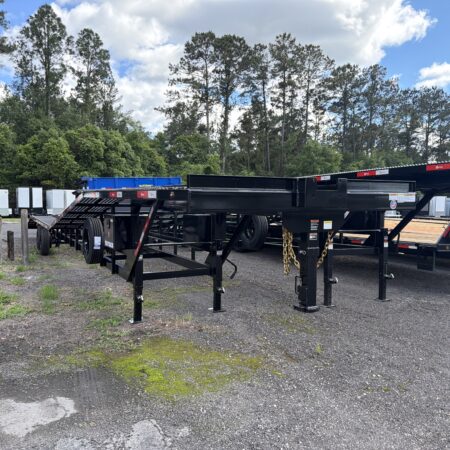
- Your Trailer: A heavy-duty tandem-axle utility or dump trailer (GVWR: 14,000 lbs)
- The Math: $10,000 + 14,000 = 24,000\text{ lbs}$ GCWR.
- The Verdict: No CDL required. Even though the trailer is well over 10,000 lbs, the total combined package stays safely under the 26,001-lb limit.
Scenario B: The Class A CDL Setup (Over 26,001 lbs)
- Your Truck: A 1-ton dually work truck (GVWR: 14,000 lbs)
- Your Trailer: The exact same tandem-axle trailer from above (GVWR: 14,000 lbs)
- The Math: $14,000 + 14,000 = 28,000\text{ lbs}$ GCWR.
- The Verdict: Class A CDL REQUIRED. Because the truck is heavier, your total capacity pushes past 26,001 lbs, and because the trailer is rated over 10,000 lbs, you legally need a commercial license.
Commercial vs. Personal Use: The Big Gray Area
The “C” in CDL stands for Commercial. If you are using your truck and trailer strictly for personal use—such as moving your own furniture to a new house or hauling your personal project car—federal CDL rules generally do not apply to standard trucks.
However, DOT officers look closely at what constitutes a “business purpose.”
Warning: If you are a landscaper hauling a commercial lawnmower, a contractor carrying shingles to a job site, or a farmer transporting cattle to an auction where you will make a profit, you are operating in commerce. At that point, the weight formulas apply strictly, and you can face heavy fines if you are caught hauling without the proper license class.
How Trailer “De-Rating” Can Help You Avoid a CDL
Because the 14,000-lb trailer trailer class is so popular among contractors, many buyers run into a wall when pairing them with beefier 1-ton trucks. To solve this problem legally, many high-quality trailer manufacturers offer a service called de-rating.
If you know you will never actually carry more than 6,000 or 7,000 lbs of payload, a manufacturer can intentionally plate a 14,000-lb capable trailer with a 12,000-lb or 9,990-lb GVWR safety sticker straight from the factory.
By lowering the official paperwork rating on the VIN tag, you can safely hook the trailer up to a larger work truck without pushing your combined GCWR over the magic 26,001-lb CDL line.
Summary Checklist: Stay Safe & Legal
Before you hook up your trailer and hit the highway, double-check your driver’s side door sticker and your trailer’s VIN plate:
- Check the truck GVWR.
- Check the trailer GVWR.
- Ensure the combined sum is under 26,001 lbs if you want to avoid a Class A license.
- Always check your specific state’s DMV guidelines, as a handful of states (like California and Texas) have unique non-commercial class endorsements for exceptionally long or heavy personal rigs.
